
Torsion vs Extension Springs: Which Does Your Garage Door Have?
Every overhead garage door is balanced by springs. The opener doesn't lift the door's weight; the springs do, and the opener just guides the door up and down. Residential doors use one of two kinds: torsion springs or extension springs. Knowing which you have helps you describe a problem accurately, understand a quote and spot what's broken from across the garage.
Delaware Garage Door Pros is a free quote service, not a garage door company. We don't repair doors, send technicians or set prices. Independent local garage door companies reply to requests and set their own prices.
What's the difference between torsion and extension springs?
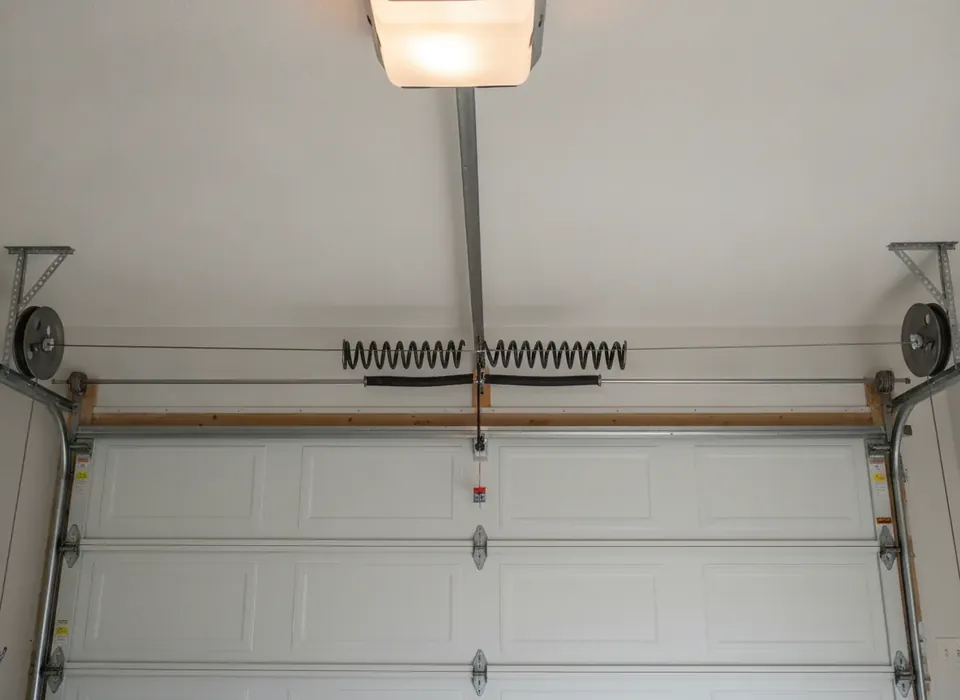
Torsion springs sit on a metal bar, called a shaft, mounted on the wall just above the door opening. Most doors have one or two springs near the middle of that bar. They twist as the door closes and unwind as it opens, turning drums at each end that wind and unwind the lift cables.
Extension springs run along the horizontal tracks on each side of the door, up near the ceiling. They stretch as the door closes and pull back as it opens, working through pulleys and cables. Each extension spring should have a safety cable running through its center, which helps contain the spring if it breaks.
| Torsion springs | Extension springs | |
|---|---|---|
| Where they sit | On a bar above the door opening | Above the horizontal tracks, one on each side |
| How they work | Twist and unwind | Stretch and contract |
| Typical life (This Old House) | 8–15 years, up to 20,000 cycles | 7–12 years, about 10,000 cycles |
| Replacement (Fixr, Jan 2025) | $200–$350 | $120–$250 |
| Installed (This Old House, Mar 2026) | $350–$540 | $300–$400 |
| Extra hardware to check | Drums, cables, bearings, center bracket | Pulleys, cables, safety cables |
How to tell which springs you have
You can identify the type from the floor without touching anything. Stand inside the garage with the door closed and the light on, and look up.
- Look at the wall above the door. A horizontal bar with one or two tightly wound coils on it means torsion springs. Some systems enclose the spring inside a tube, so you may only see a metal tube with a drum at each end.
- Look along the side tracks. Long springs running parallel to the ceiling tracks, one on each side, connected to pulleys, mean extension springs.
- Take a photo. A clear photo from a few steps back is usually enough for a company to confirm the type, and it helps when you request quotes.
Look, don't touch. Don't climb a ladder to inspect a spring up close, loosen screws on the bar or pull on a cable. Every part of the system is under tension when the door is closed.
What a broken spring looks like
A broken torsion spring usually shows a clear gap of an inch or two somewhere along the coil. A broken extension spring may hang loose, look stretched out of shape or leave a pulley sagging. Other common signs, whichever type you have:
- A loud bang from the garage, often when no one was using the door.
- The door feels very heavy, or the opener strains, lifts it a few inches and stops.
- The door goes up crooked, or one side lags behind the other.
- A cable hangs slack or has come off its drum or pulley.
If you see any of these, stop using the door and get it looked at. The broken spring repair page explains what a technician typically does, and the off-track and cable repair page covers loose or snapped cables.
Is one type better than the other?
Neither is right for every door, and both are still installed on homes today. The trade-offs look like this:
- Torsion: smoother balance and longer rated life. Because the force is spread along one bar, the door tends to lift evenly. This Old House puts typical torsion life at 8–15 years. The downside is cost: torsion replacement runs higher in both published guides.
- Extension: lower cost, more moving parts. Extension springs are generally cheaper to replace, but pulleys, cables and safety cables add wear points, and This Old House puts their typical life a little shorter, at 7–12 years.
Which type a door came with depends on the door's weight, the headroom above it and the builder or installer. On a heavy double door, torsion springs are common. On a light single door, either can work.
Can you switch from extension to torsion springs?
Some companies offer conversions, and whether it makes sense depends on the door, the track and the headroom above the opening. If your extension springs need replacing anyway, it's reasonable to ask for two prices: like-for-like replacement and a conversion. Ask exactly what the conversion includes (bar, drums, cables, bearings, brackets) and whether any track work is needed. Compare that against the cost of simply replacing the extension springs and safety cables.
Safety: the part that doesn't change by spring type
Leave springs to a trained technician. Torsion springs store enough energy to cause serious injury. Leave spring and cable work to a trained technician. Extension springs are also under heavy tension whenever the door is closed, and the safety cable through each one is there to help contain a breaking spring. If yours are missing, mention it when you request quotes.
If a spring breaks while the door is closed, leave it closed and don't keep pressing the opener button. If it breaks with the door open, keep people, pets and cars out of the opening until a technician has secured it.
How long do torsion and extension springs last?
Standard springs of either type are commonly rated around 10,000 open-close cycles. At four cycles a day that's roughly seven years; a household that uses the door less may get well over a decade. DASMA, the door manufacturers' association, notes that rust and poor lubrication shorten spring life, and cold weather often reveals a worn spring. Columbus-area normals show about 103 nights a year at or below freezing (NOAA 1991–2020). The full breakdown is in the post on how long garage door springs last, and a garage door tune-up is the usual way to keep hardware lubricated and checked.
What this means for your quote
When you request quotes, say which spring type you have, whether the door is single or double, whether one or both springs look broken, and roughly how old the door is. A photo helps. Then compare quotes on the same points: one spring or two, cycle rating, trip fee and any extra parts.
For repairs over $25, Ohio rules generally require the company to let you choose a written, oral or no estimate before work starts, and to tell you up front about trip, service-call or diagnostic charges (Ohio Adm. Code 109:4-3-05). Ask for a written estimate and an itemized bill. The spring replacement cost post and the Delaware, Ohio repair cost guide have the published ranges.
Ready to get prices? Use the free quote form or call (740) 471-1706. Independent local garage door companies can reply, and there's no obligation.
Frequently asked questions
How do I know if I have torsion or extension springs?
Look up from inside the garage with the door closed. Coiled springs on a bar above the door are torsion springs. Long springs running beside the ceiling tracks on each side are extension springs. Look without touching; every part is under tension.
Which lasts longer, torsion or extension springs?
This Old House puts typical torsion spring life at 8–15 years (up to 20,000 cycles) and extension springs at 7–12 years (about 10,000 cycles). How often you use the door, rust and lubrication all affect the real number.
Which is cheaper to replace?
Extension springs usually cost less. Fixr lists extension spring replacement at $120–$250 and torsion at $200–$350 (Jan 2025). This Old House lists $300–$400 and $350–$540 installed (Mar 2026). These are published estimates, not quotes.
Is it safe to open the door with a broken spring?
No. The door may be far heavier than it looks, and the opener isn't built to lift its full weight. If it's closed, leave it closed and call a local company. Don't touch springs or cables.