
How Long Do Garage Door Springs Last? Cycle Ratings, Wear and Warning Signs
Garage door springs do the heavy lifting. The opener only guides the door; the springs carry most of its weight. Every time the door goes up and comes back down, the springs complete one cycle, and like a paper clip bent back and forth, they eventually wear out.
So how long do garage door springs last? The honest answer is a range, and it depends more on how often you use the door than on how many years have passed. This guide explains cycle ratings, what shortens spring life in central Ohio, and the signs that a spring is near the end.
The short answer: cycles, not years
Standard springs are commonly rated around 10,000 cycles. One cycle is one full open and close. Here is how published guides put it:
| Source | What it says |
|---|---|
| This Old House, Mar 2026 | Extension springs about 7 to 12 years, around 10,000 cycles. Torsion springs about 8 to 15 years, up to 20,000 cycles. |
| Fixr, Jan 2025 | Springs rated for a minimum of 10,000 cycles; some extension springs reach 20,000. |
| DASMA (door manufacturers' association) | No single number. Spring cycle life may not match the door's own cycle life, and rust and poor lubrication shorten it. |
Turn cycles into years with simple math. A 10,000-cycle spring used four times a day lasts roughly seven years. Used twice a day, it lasts about 14. A household that uses the garage as its front door, with several drivers coming and going, can wear through a standard spring much faster than a retired couple who drive once a day.
How to estimate your own springs' age
Count a typical day
Count every open and close for a few days: commutes, school runs, errands, letting the dog out, kids grabbing bikes. Four to six cycles a day is common for a busy household.
Multiply by 365
Five cycles a day is about 1,800 a year. At that pace, a 10,000-cycle spring would be near the end of its rating in five to six years.
Check the paperwork
If the springs were replaced before, the invoice may list the spring size or cycle rating. If they are original, the home's build year is a rough starting point.
That last point matters here. Delaware County's median home was built in 2000, compared with 1970 for Ohio as a whole, and about two-thirds of homes were built between 1990 and 2019 (ACS 2020–2024). In Orange Township around Lewis Center, the median build year is 2004. Many of those homes are on their original springs or their second set, which is why spring calls are so common across the county.
What shortens spring life in central Ohio
Rust. DASMA's technical guidance says rust reduces the effective area of spring wire and that corrosion pits speed up fatigue cracks. Humid garages and road salt carried in on cars in winter are both plausible contributors, though no Ohio-specific study was found.
Missing lubrication. The same DASMA guidance says regular lubrication helps maximize spring cycle life. A yearly garage door tune-up usually includes it.
Cold mornings. The Columbus area averages about 103 nights a year at or below freezing, with a January average low of 22°F (NOAA 1991–2020 normals, Columbus airport). Cold thickens grease and stiffens rollers, so the door works harder. Cold weather often reveals a worn spring rather than breaking a healthy one, which is why so many failures seem to happen on the first frosty morning. Our post on garage doors that won't open in cold weather covers the other winter culprits.
Door weight and balance. A heavy double door, an added window section or insulation can change what the springs carry. If the springs weren't sized to the door, they work harder every cycle.
Torsion vs extension: does spring type change lifespan?
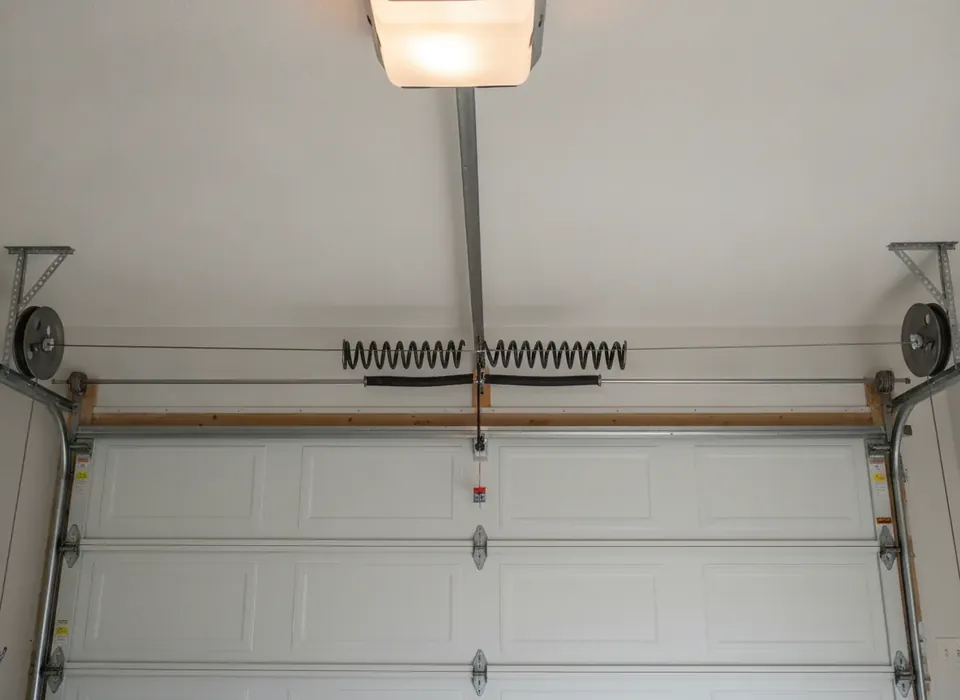
Published guides give torsion springs a slightly longer typical life than extension springs, and some torsion springs are rated well above 10,000 cycles. Some companies offer higher-cycle springs as an option; if you use your door heavily, ask what cycle rating a quote includes. For the differences in how the two types work and what they cost, see torsion vs extension springs.
Signs a garage door spring is wearing out
- A loud bang from the garage, often when no one is using the door.
- A visible gap of an inch or two in a torsion spring coil.
- The door feels very heavy, or the opener strains, slows or stops partway.
- The door rises unevenly or looks crooked as it moves.
- Extension springs that look stretched, rusty or uneven side to side.
- The door won't stay put when partly open and drifts down quickly.
Safety first
Torsion springs store enough energy to cause serious injury. Leave spring and cable work to a trained technician. If you suspect a broken spring, don't force the door or keep pressing the opener. If the door is fully closed, you can leave it closed. If it's stuck open, keep people and cars out from under it and call a company.
Should both springs be replaced at once?
Many technicians recommend replacing springs in pairs on doors that have two. Both springs have done the same number of cycles, so when one fails the other is usually close behind, and a matched pair helps the door stay balanced. Ask whether a quote is for one spring or two, and what spring rating is included. Our broken garage door spring repair page explains the job, and the spring replacement cost guide covers published prices in detail.
Ohio's repair estimate rule
For repairs over $25, Ohio rules generally require the company to let you choose a written, oral or no estimate before work starts, and to tell you up front about trip, service-call or diagnostic charges (Ohio Adm. Code 109:4-3-05). Ask for a written estimate and an itemized bill. This is general information, not legal advice. More detail: your repair estimate rights in Ohio.
When you're ready, you can request free quotes from independent local companies in Delaware, Ohio and nearby towns, or call (740) 471-1706. Mention whether the car is stuck inside so companies know how urgent it is. You can also compare published ranges in the garage door repair cost guide.
Frequently asked questions
How long do garage door springs last?
Standard springs are commonly rated around 10,000 open-close cycles. Published guides put that at roughly 7 to 14 years, depending on use. This Old House (March 2026) lists extension springs at about 7 to 12 years and torsion springs at about 8 to 15. A busy household wears springs out sooner.
How many cycles is a garage door spring good for?
Most standard residential springs are commonly rated around 10,000 cycles, and Fixr (January 2025) calls that a minimum. Some springs are rated for 20,000 cycles or more. One cycle is one full open and close, so four cycles a day uses up about 1,460 a year.
Why do garage door springs seem to break in winter?
Cold weather often reveals a worn spring rather than breaking a healthy one. Grease thickens and rollers stiffen, so the door works harder on a cold morning, and a spring near the end of its cycle life may give out. The Columbus area averages about 103 nights a year at or below freezing.
Can I make my garage door springs last longer?
Regular lubrication helps, according to DASMA, and keeping rust in check matters because corrosion speeds up fatigue cracks. A yearly tune-up and balance check from a local company is the practical route. Any spring adjustment or replacement should be left to a trained technician because the springs are under high tension.